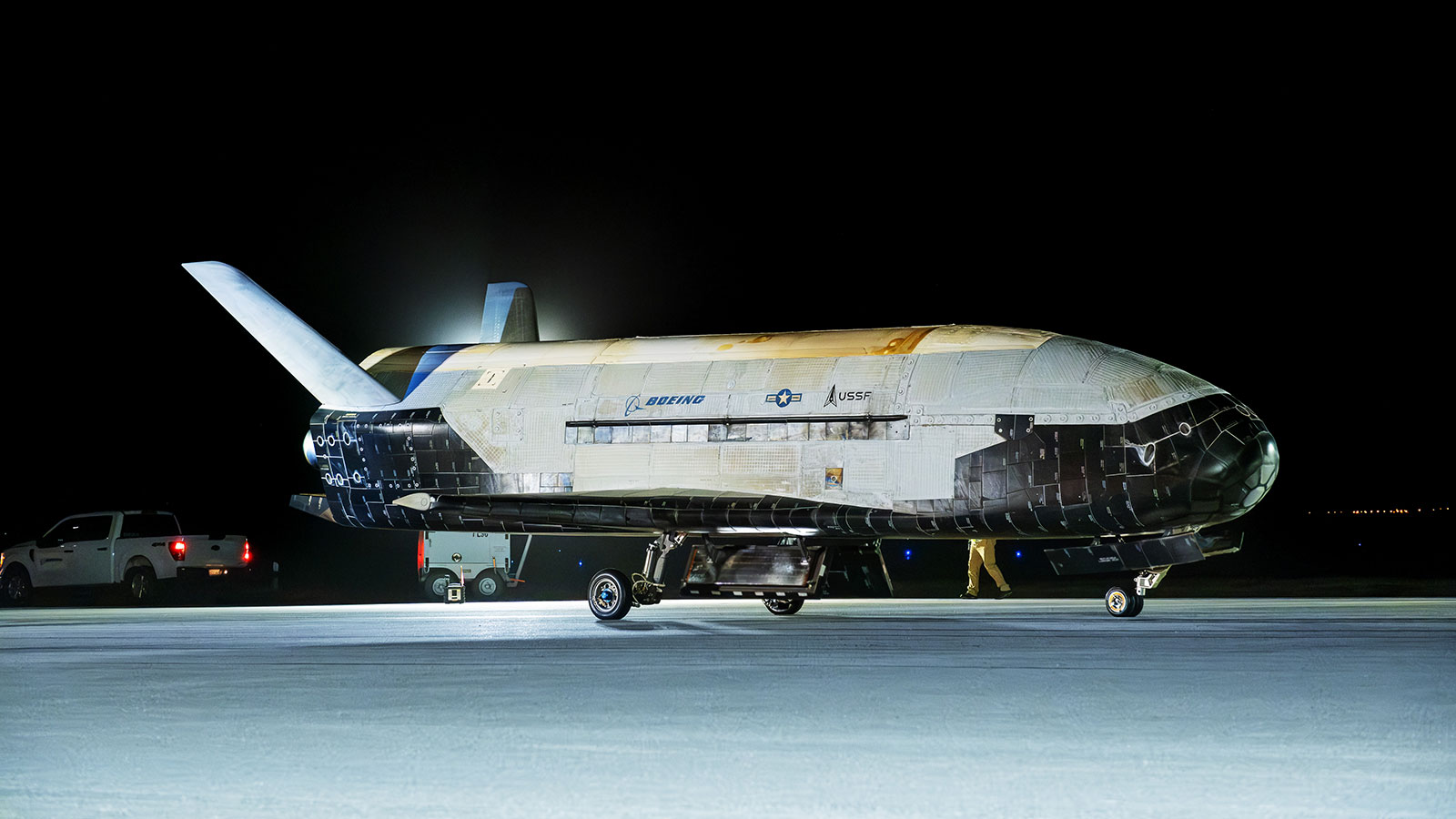
Catch up quick: OTV-8 launched in August 2025, less than six months after the X-37B completed its seventh mission.
- “That pace said something important about the platform and the team behind it,” said Holly Murphy, director of Boeing’s Experimental Systems Group. “This is not a one-off spacecraft. It is a mature, reusable vehicle built to support increasingly sophisticated missions over time.”
Mission details: On its current mission, the X-37B is hosting publicly disclosed experiments, including laser communications, a quantum inertial sensor and NASA material exposure research tied to inflatable heat shield technology.
- Laser communications could help future architectures move more data across distributed networks.
- Quantum inertial sensing could support navigation when GPS is unavailable or degraded.
- The NASA research is studying how Zylon webbing materials used in hypersonic inflatable aerodynamic decelerator, or HIAD, technology respond to long-duration exposure to the harsh space environment. That work could help inform future approaches for protecting materials used in planetary entry systems.
- Boeing’s role is to make those missions possible by delivering a reliable, adaptable vehicle that can carry evolving technologies and support demanding on-orbit needs.
The big picture: The mission also builds on momentum from OTV-7. During that mission, the X-37B completed a first-of-its-kind aerobraking maneuver to change orbits while conserving propellant. That demonstration mattered because it showed how the platform can operate more flexibly in space, giving mission planners freedom of maneuver without sacrificing precious fuel.
- “Reusability only matters if it keeps delivering value mission after mission,” said Kay Sears, vice president and general manager of Boeing Space, Intelligence & Weapon Systems. “The X-37B gives our government partners a proven platform they can keep building on, one that helps them test advanced technologies in orbit, bring hardware home, and turn what they learn into more capable future systems.”
The bottom line: What sets the X-37B apart is the embedded learning loop. The spaceplane can fly new experiments; operate for extended periods; and then return so teams can inspect hardware, evaluate performance and apply those lessons to future flights. That cycle helps reduce risk and advance future mission designs.
- “At Boeing, that means continuing to evolve the platform itself,” Murphy said. “As mission partners bring forward more advanced experiments, the vehicle must keep pace. Capacity, integration, mission flexibility and operational reliability all matter. That is part of the value Boeing provides through design, build, integration and mission support.”
By Zeyad Maasarani